Stark C2
Minerva
Mission Operating System
Our Mission Operating System is built for real-world operations.
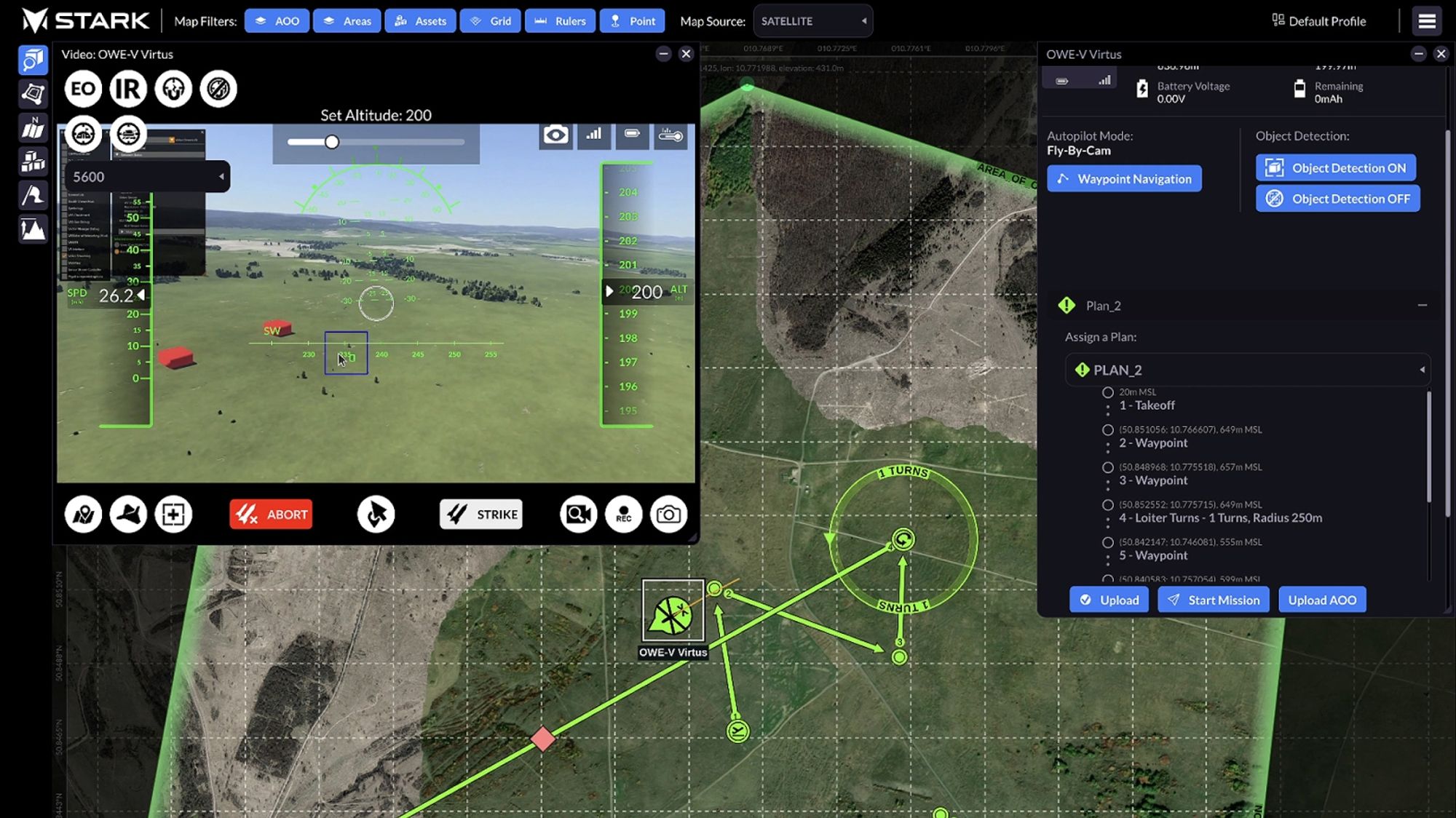
Introducing our Command and Weapons Control (C2) system: Minerva.
We break the single operator, single vehicle paradigm by giving one individual the power to control a swarm of unmanned systems. STARK’s software is human-centred, swarm-capable, and designed for seamless interoperability across platforms and military IT infrastructure.
Modular Open SYSTEM Architecture: Digital sovereignty for today’s Armed Forces
Modern missions need a Command and control (C2) system that is sovereign, flexible, and future-proof but proprietary solutions only partially meet these requirements. This is why STARK uses a Modular Open System Architecture (MOSA) approach for the core of our C2 technology.
Why use an open C2 UMS Core?
- Full Digital Sovereignty: The C2 UMS Core is fully owned by the military user. Development, operation, and maintenance remain entirely under the user’s control.
- Maximum Flexibility: It can be developed and adapted at any time without the burden of relying on individual vendors.
- Future-Proof Design: Open C2 Core will evolve into a durable, functional standard that is NATO compliant.
- Ready for Future Swarm Operations: This technology will be central for enabling advanced swarming capabilities of unmanned systems.
Our Contribution: Expertise, Architecture, Implementation
We bring extensive experience from the development of the Minerva C2 software as well as deep expertise in reconnaissance and strike operations, particularly in the integration of unmanned systems such as loitering munitions.
We support our partners with:
- Proven Architecture: We directly transfer established architectures and best practices from Minerva into the open-architecture development process.
- Cooperative Development: We jointly develop the C2 UMS Core with its users and ensure it is consistently aligned with future operational needs.
- Neutrality and Interoperability: Our approach is vendor-agnostic and standardised in the way it integrates unmanned systems into the military decision-making process within SitaWare, TAK, or MESE.